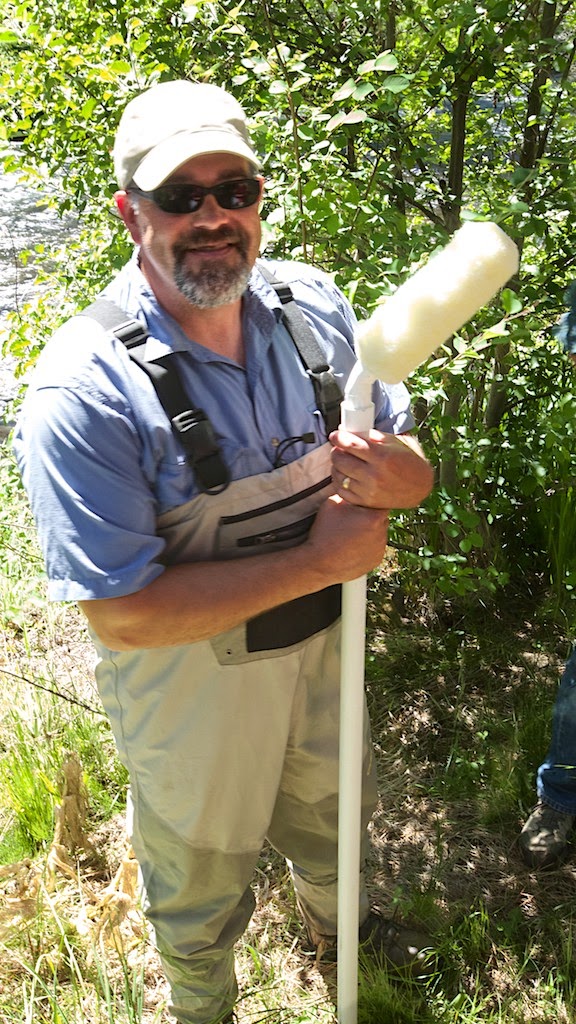
He writes, "The time has come for me to pass the baton and head for the locker room. I’ll be retiring in November. The Department has generously allowed me several weeks to wrap up loose ends. One of those is downloading information that that might be useful to those still in the race. Here is a look back at how Oregon has responded to invasive species in the last few decades. My focus is on ODA insect and weed programs where I have first-hand knowledge."
The Early Years
1960's - Recognition of the Risks
Prior to the 1960’s, ODA surveys focused on documenting pest population levels of established agricultural pests. By the late 1960’s, this evolved to include surveys for pests threatening to invade but not known to occur in Oregon, including Japanese beetle, cereal leaf beetle, and Khapra beetle. One of my predecessors, Bill Kosesan, recognized the risk. He wrote in 1968: “Because we travel more and faster these days and move plants, food, forest, and fiber products in greater quantities, the danger of spreading plant pests is greatly increased.” “If present trends are any indication Oregon can expect more pest invasions, not fewer.” 1Gypsy Moths
In 1977, Oregon began annual surveys for gypsy moth, one of the worst forest pests ever to invade North America. Two years later, Diana Kearns, who still works for us, reported the first positive trap in West Linn. The first infestation to trigger an eradication treatment occurred in Salem in the early 1980’s. Mill Creek, right outside ODA headquarters, was covered with plastic to minimize insecticide getting into the water. That was good practice for 1984 when a very large infestation was discovered in Lane Co. 19,096 gypsy moths were caught that year triggering a massive aerial assault that grew to include a quarter of a million acres. 2 The State Legislature allocated several million dollars for the treatments and continued monitoring. Due to concern about spraying residential neighborhoods with chemical pesticides, ODA pioneered use of B.t., a naturally occurring biological insecticide, for this large-scale eradication project. It took three applications per year applied by helicopter for several years, but happily it worked. We’ve continued to rely on that technique for the last three decades and the funding that came in response to that outbreak.1990's - the Federal Government
In 1993, the U.S. Congress’s Office of Technology Assessment came out with a report on “Harmful Non-Indigenous Species in the United States.” 3 The following year, the U.S. Dept. of Agriculture came out with “Biological Pollution: A Serious New Environmental Challenge.” That report concluded: “What is needed is a national initiative to properly address the issue of harmful non-indigenous species as biological pollutants. Such a national initiative would provide a mechanism whereby all federal, state, and private agencies could join in a holistic effort to deal with the problem.“ 4The term “invasive species” wasn’t commonly used until President Clinton signed executive order 13112 on Feb. 3. 1999, entitled “Invasive Species.” 5 His order created the national invasive species council and it’s advisory committee. I remember reading that order, especially one particular paragraph that read: “Among other things, the advisory committee shall recommend plans and actions at local, tribal, State, regional, and ecosystem-based levels to achieve the goals and objectives of the management plan in section 5 of this order.” Somebody should do that in Oregon, I thought. The idea stayed with me.
The Start of the Oregon Invasive Species Council
Eventually I called Dr. Mark Systma, Oregon’s aquatic nuisance species guru at PSU. He’d also read the executive order and was thinking along the same lines. We pulled in Paul Heimowitz from OSU Sea Grant and Larry Cooper from Oregon Dept. of Fish and Wildlife and together drafted a legislative concept that would create an Invasive Species Council in Oregon. We made it easy for legislators by suggesting funding for the Council come from reassigning a few thousand dollars that were going toward a moribund interagency IPM committee. Momentum built through 2000 when OSU hosted a Biology Colloquium called: Biological Invasions! The Quiet Global Change. The legislature responded and the Oregon Invasive Species Council (OISC) was born a year later.OISC included ex officio members from State agencies that deal with invasive species plus appointed at large members representing “the geographic, cultural and economic diversity of this state.” The Council’s purpose was, and is, to:
- Facilitate reporting of invasive species,
- Educate people about related issues,
- Develop a statewide plan for addressing invasions, and
- Provide grants or loans for eradicating new invasions.
Impact
OISC has made a difference. Oregon’s 1-866-INVADER hotline facilitated reporting right out of the gate and then it’s online counterpart http://oregoninvasiveshotline.org made it even easier to connect people noticing suspicious animals and plants to experts that can identify them and respond if necessary. Public awareness has also improved. In 2005, OISC contracted with Anthill Marketing to do a random telephone survey of Oregonians’ knowledge of invasive species. 6 The conclusion was: “The average Oregonian does not understand what nuisance or invasive species are other than perhaps weeds.” In 2007, Lisa DeBruyckere, was hired as the first OISC Coordinator. She made an instant impact coordinating an educational campaign. Especially effective were a series of articles in the Statesman Journal by Beth Casper, and an hour-long OPB special directed by Ed Jahn called the “Silent Invasion.” Public awareness improved to the point it became rare to encounter someone who didn’t have some knowledge of the issue. That is a big change from early legislative hearings when Mark, Paul, Larry, and I were questioned about zebras and giraffes!The OISC has produced two action plans, the first in 2003 and an update in 2012. The original is notable for it’s Appendix III that provides a baseline list of 341 invasive species established in Oregon in 2000. 7 A noxious weed strategic plan and an economic assessment of the impact of invasive weeds came out in 2001. 8 9 Look for an updated economic assessment is in the works. Stay tuned for that; the documentable impacts are increasing. Also in 2001, Oregon’s Aquatic Nuisance Species Management Plan made its debut. 10 This was followed by a Feral Swine Action Plan for Oregon in 2007. 11 The granting function of the Council is mostly a dream because of the inadequate size of the emergency fund and the lack of a mechanism to replenish it. However, OISC has contributed funding toward the effort to eradicate Japanese beetles from the Portland airport and to address invasive tunicates in the Charleston boat basin and Umpqua triangle. More on funding later.
EDRR
Gypsy moth is our poster species for successful early detection and rapid response (EDRR) in Oregon, but there are other examples including:Insects. In 1989-‘91 ODA detected and eradicated Japanese beetle infestations in Cave Junction, Rivergrove, and Tigard. Several other infestations have been eradicated since then and a current effort to eliminate JB’s at PDX is ongoing. In 2008 an infestation of granulate ambrosia beetle was eradicated from The Dalles.
Weeds
Kudzu, the weed that ate the South, was detected in Oregon in 2000. Four sites in Clackamas and Multnomah Counties have been eliminated since. We’ve also eradiated several Spartina infestations on the coast and we’re working on purple starthistle, giant hogweed, Patterson’s curse, distaff thistle, African rue, and yellow-tuft alyssum. Weeds are harder to eradicate because there is a seed bank in the soil; it takes a sustained effort.Plant Diseases
In 2001 sudden oak death was detected in Curry County. Though the eradication effort ultimately failed, we did greatly limit the spread and impact of this disease and we’ve minimized the importance of nursery stock as a vector. Chrysanthemum white rust, was introduced a couple of times, hasn’t yet established here.When I look at where we are today, I see a lot of positives -- and one big dark cloud. We’re doing some EDRR in Oregon, we have great people in key positions, our laws and regulations have been updated, and we work together well across agencies and organizations. Our challenge is that globalization continues to accelerate and along with it the rate of introduction of new invaders. At the same time government funding for survey and response programs is static or declining. Even if it were available, I don’t think spending more tax dollars is the answer. What we need is a way to link funding for EDRR to globalization.
Funding for Protecting Oregon against Invasive Species
Earlier this year the OISC proposed a 1% pathways assessment on existing fees related to trade and travel. That type of linkage would make a huge difference; funding would increase with heightened risk or decrease if globalization slowed. I’m convinced that is where we need to go. The people and businesses that are engaging in trade and travel should be supporting efforts to prevent negative side effects. I like the “polluter pays” concept; it just makes sense. Let’s keep working on it.Introducing Dr. Helmuth Rogg
Dr. Helmuth Rogg is my replacement as Director of Plant Programs at ODA; he has already taken the baton and sprinted off to a great start. I’ll be cheering from the sidelines as he leads us on the next leg of the rat race, pig race, beetle race, weed race, plant disease race, etc. There is no finish line to the invasive species chase; for us, keeping up is winning.Good luck Helmuth, good luck ODA, good luck OISC, good luck Oregon, good luck USA, and good luck Earth!
--- Dan
________________________________
References
1. Kosesan, W.H. Plant Protectors. 1968. Oregon Agrirecord, State Dept. of Agriculture, Salem, OR. No. 239, pp. 11-12. ↩
2. Plant Division Annual Report 2005. Gypsy moth. Oregon Dept. of Agriculture, Salem, OR. pp.23-24.↩
3. U.S. Congress, Office of Technology Assessment, Harmful Non-Indigenous Species in the United States. OTA-F-565 (Washington, DC: U.S. Government Printing Office, September 1993).↩
4. Westbrooks, R.G. and R.E. Eplee. 1994. Biological Pollution: A Serious New Environmental Challenge, An Exposé on the Ecological Significance of Harmful Non-indigenous Species. U.S. Dept. of Agriculture, APHIS, PPQ, Whiteville Plant Methods Center, Whiteville, North Carolina. 5 pgs. ↩
5. Presidential Documents, Executive Oregon 13112. 1999. Invasive Species. Federal Register, Vol. 64, 6183-6186. ↩
6. Oregon Invasive Species Council, Statewide Awareness Campaign Plan. 2005. Ant Hill Marketing. 19 pgs.↩
7. Oregon Invasive Species Action Plan. 2003. Oregon Invasive Species Council, Mark Systma, Chair, Center for Lakes & Reservoirs, Portland State University, Portland, OR 97207-0751. 38 pgs.↩
8. Oregon Noxious Weed strategic Plan. 2001. Oregon Dept. of Agriculture, 635 Capitol St. NE, Salem, OR 97301-2532. 66 pgs.↩
9. Economic Analysis of Containment Programs, Damages, and Production Losses From Noxious Weeds in Oregon. 2000. Prepared by The Research Group, Corvallis, Oregon, for the Oregon Dept. of Agriculture, Noxious Weed Control Program, Salem, Oregon.↩
10. Oregon Aquatic Nuisance Species Management Plan. 2001. Center for Lakes and Reservoirs, Portland State University. 86 pgs. ↩
11. Rouhe A. and M. Sytsma. 2007. Feral Swine Action Plan for Oregon. Environmental Science and Resources, Portland State University. 28 pgs.↩